



For years, differential pressure sat in the background of compounding pharmacy monitoring programs — tracked less consistently than temperature and humidity, and enforced less rigorously. Now it’s at the top of auditors’ checklists.
This article covers the regulatory history behind that shift, the specific direction and threshold rules United States Pharmacopeia (USP) <797> and USP <800> require, and how cascade coverage across the full classified environment protects your compliance record.
Why Differential Pressure Stability Is Crucial for Compound Purity
Differential pressure control in a compounding cleanroom protects the integrity of your formulations by maintaining an invisible aerodynamic barrier. When pressure differentials fluctuate or drop, the physical direction of airflow changes, carrying severe consequences for cleanroom compliance.
Microbial Contamination Risks
A drop in positive pressure allows unfiltered air from lower-classified spaces to rush into the buffer room, instantly introducing airborne particulates and microbial contaminants into your sterile field.
Personnel and Facility Safety Hazards
In hazardous compounding environments, a loss of negative containment pressure eliminates the barrier that prevents toxic chemical vapors or hazardous drug particles from escaping into safe staff zones.
Immediate Audit and Batch Failures
Because airflow direction is your first line of defense, a single undocumented differential pressure excursion will trigger an environmental monitoring compliance failure, forcing immediate batch quarantines and costly corrective actions.
The Outbreak That Changed Compounding Pharmacy Compliance
In 2012, the New England Compounding Center (NECC) outbreak of fungal meningitis traced to contaminated compounded spinal injections killed 64 people and exposed how badly environmental controls had failed across compounding facilities. Federal investigations followed and regulations tightened.
In 2023, the revision of USP General Chapter <797> completed that shift by making continuous, retrievable differential pressure documentation a formal requirement. This established the standard not as a facility preference or a periodic check, but as a mandated compliance requirement tied directly to patient safety that every compounding pharmacy is now held to.

Pressure Direction Depends on What You Compound
The required pressure direction in your compounding space is determined by what you produce. USP <797> and USP <800> have distinct requirements:
| Compounding Type | Pressure Direction | Minimum Threshold |
| Non-hazardous sterile compounding (USP <797>) | Positive pressure | 0.020-inch water column (4.98 Pa) |
| Hazardous drug compounding (USP <800>) | Negative pressure | 0.01 to 0.03-inch water column (≈2.49–7.47 Pa) |
Facilities that handle both non-hazardous compounded sterile preparations (CSPs) and hazardous drugs manage opposite pressure relationships simultaneously.
When an excursion occurs in either space, the environmental monitoring compliance response requires a documented record showing exactly when the deviation happened, how long it lasted, and what action was taken. When your data lives in two completely separate formats, matching them up creates tedious paperwork and opens the door for compliance gaps.
Why Anteroom Monitoring Is Key
One of the cleanroom’s most critical transitional checkpoints is the anteroom.
USP <797> requires a minimum 0.020-inch water column (4.98 Pa) pressure difference between each classified space from cleanroom to anteroom, and anteroom to hallway. Differential pressure is a measurement of the relationship between two spaces. A sensor covering only the buffer room does not document the cascade between the buffer room and the anteroom.
This results in three compliance blind spots that can lead to:
Contaminant Buildup
If anteroom pressure fails, airborne particles quietly pool in that transitional space, even if your main buffer room readings look perfect.
Foot Traffic Transfer
Every time staff open the door to move gowning, equipment, or materials, those trapped contaminants get swept directly into your sterile space.
Hidden Audit Risks
Because your compounding room sensor stays in range, no internal data will flag the issue until an auditor uncovers the contamination.
Monitoring every tier of the cascade is important because it proves your facility design holds up during active, real-world compounding shifts.
How Dickson Addresses Differential Pressure Monitoring
USP <797> sets specific requirements that your monitoring hardware needs to support, including:
- Verification of annual calibration for temperature, humidity, and differential pressure sensors
- All data must be instantly ready for an auditor’s review without manual log reconstruction
- Continuous parameter tracking for high-risk Category 3 compounding with more frequent viable air and surface sampling
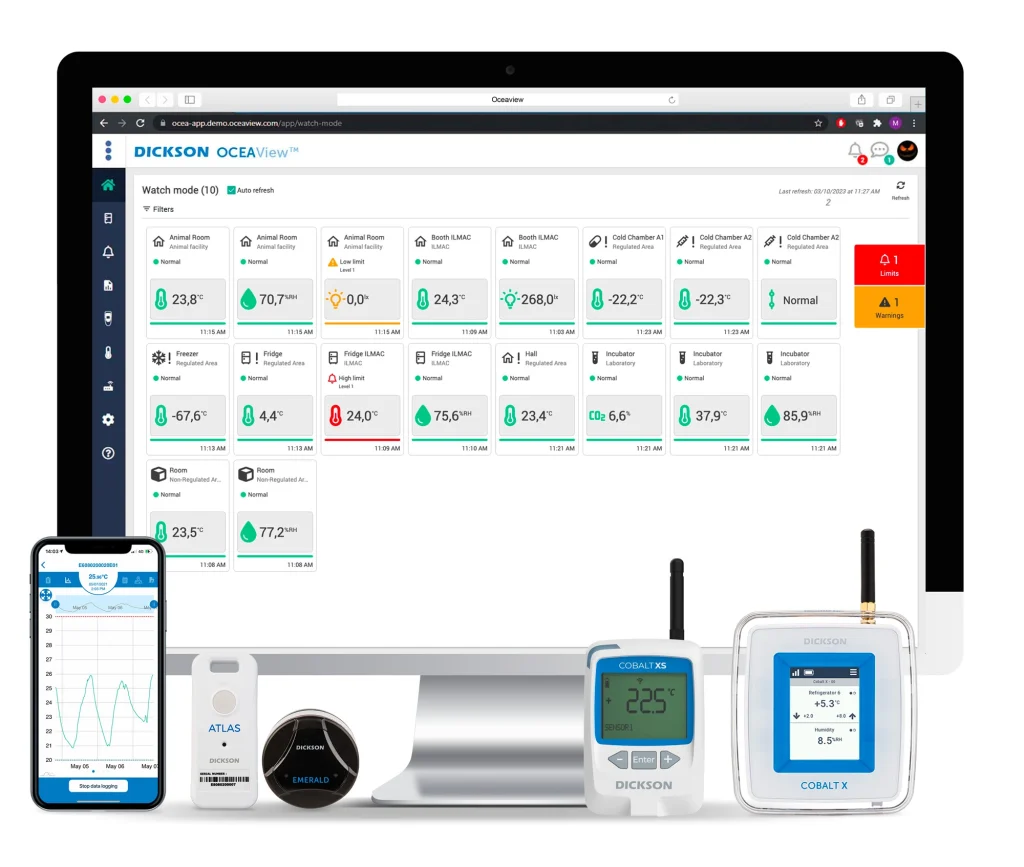
To meet these strict compliance standards without creating extra paperwork for your staff, you need a monitoring platform built specifically for heavily regulated pharmacy spaces. Dickson’s cloud-connected data loggers automate this entire process by continuously capturing your critical parameters and streaming them directly to a centralized dashboard.
Cobalt X Data Logger
Cobalt X, Dickson’s most versatile data logger for cleanroom environments supports up to four simultaneous sensors including temperature sensors, humidity sensors, and differential pressure Smart Sensors (-250 Pa to +250 Pa). The 4-20 mA universal input also allows integration with third-party DP transducers already specified for your cleanroom. Features include a glove-compatible touchscreen for on-site alarm acknowledgment and transmission via LoRaWAN to the DicksonOne platform.

DicksonOne Display Logger
Designed for facilities that need both continuous cloud monitoring and a visible at-a-glance readout inside the compounding space. Provides real-time on-site readings alongside full cloud-based data capture and real-time alerting.
Pressure Data Logger
Built for applications that require dedicated, standalone pressure documentation. Captures precise differential pressure readings over time with on-board memory storage, which makes it well-suited for spaces where network connectivity is limited or a separate pressure record is preferred.
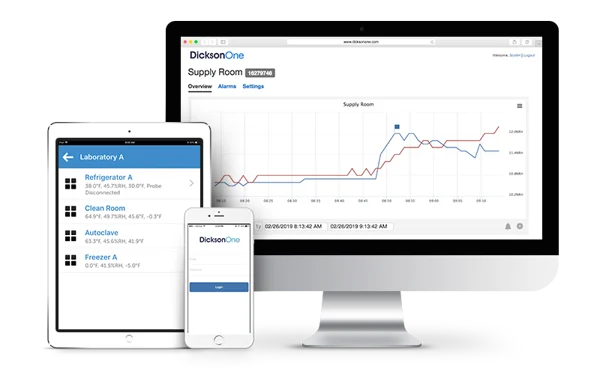
All three data loggers connect to the DicksonOne or OCEAView dashboard, where buffer room, anteroom, and corridor pressure data sit alongside temperature and humidity readings in a single view with exportable compliance reports.
Explore Dickson Monitoring Solutions for Compounding Pharmacies →
Download Pharmaceutical Environmental Monitoring Handbook→
Differential Pressure Frequently Asked Questions
How to Place Data Loggers for Mapping Studies and 3 Ways Dickson Can Help
When it comes to temperature mapping, these two questions create the most confusion: how many loggers do I need, and where exactly should they go?…

What to Look for in a GxP Metrology Partner for Pharmaceutical Manufacturing
In pharmaceutical manufacturing, there are moments that reveal whether your monitoring vendor is also a true GxP metrology partner. A temperature sensor found out of…

4 Features That Set the Cobalt X Data Logger Apart in Multi-Environment Facility Monitoring
Regulated facilities aren’t simple environments. A single floor might contain ultra-low temperature freezers, CO₂ incubators, a cleanroom, and a cold storage room with different temperature…

Beat the Heat with These Summer Mapping Tips for Audit-Ready Compliance
A winter mapping study gives facility managers for pharmaceutical storage control at warehouses, cold chain distribution centers, and clinical storage facilities valuable data, but only…
Ready to chat?
Talk To A Specialist
Our trained team of professionals is ready to help you through the compliance process from start to finish. Reach out today to start the conversation. Call (630) 563-4209 or send us a message.