



For pharmaceutical manufacturers, you know environmental monitoring systems are a key part of any quality management system, essential for pharmaceutical storage control, and serve as your first line of defense in an audit.
While many systems can log data, only a select few are truly built to help you navigate the complex challenges of a GxP regulated environment.
If you are looking to simplify the audit process, increase your team’s efficiency, and protect your products, there are six basic questions you should be asking to evaluate an environmental monitoring system’s capabilities.
1. How does the monitoring system provide secure, validated records?
When dealing with high-value biologics and vaccines, having a detailed, unalterable, and traceable audit trail is a major requirement. You’ll want to make sure the monitoring system’s audit trail tracks user activity and responses, as well as all system actions. This ensures you can prove what happened, who responded, what actions were taken, and when they were made.
To check if your system has these capabilities, pharma manufacturers in the United States should inquire whether the environmental monitoring system is built in accordance with the FDA’s 21 CFR Part 11 guidelines (or equivalents such as EudraLex Annex 11 and WHO Annex 9) to ensure data integrity.
A compliant system will automatically capture a detailed history of all system events, including:
- Alarms, user-specific acknowledgment, and annotations
- User login and logout
- Configuration changes
- New equipment, data loggers, and sensors
- Profile updates
- Alert rule creation, modification, and testing
- Data logging start and stop
- System messages
- Password changes
2. What happens if there is a power outage or loss of network connection?
Some environmental monitoring systems have little to no internal memory, and rely on a constant internet connection to transmit data. In the event of a power or internet outage, these systems can pose a significant compliance risk.
To avoid the pain of irretrievable data loss during a power outage, your environmental monitoring system should:
- Provide alerts about the outage
- Continue to log data on battery backup power and store it in local memory
- Transmit data automatically once the power or internet connection has been restored
Other environmental systems use long-range LoRaWAN data loggers to maintain a stronger internet connection in remote areas and provide Ethernet or cellular backup connectivity so your data stays online and accessible even when your primary network is down.
3. Can the monitoring system give us a live view of all of our assets, regardless of their physical location?
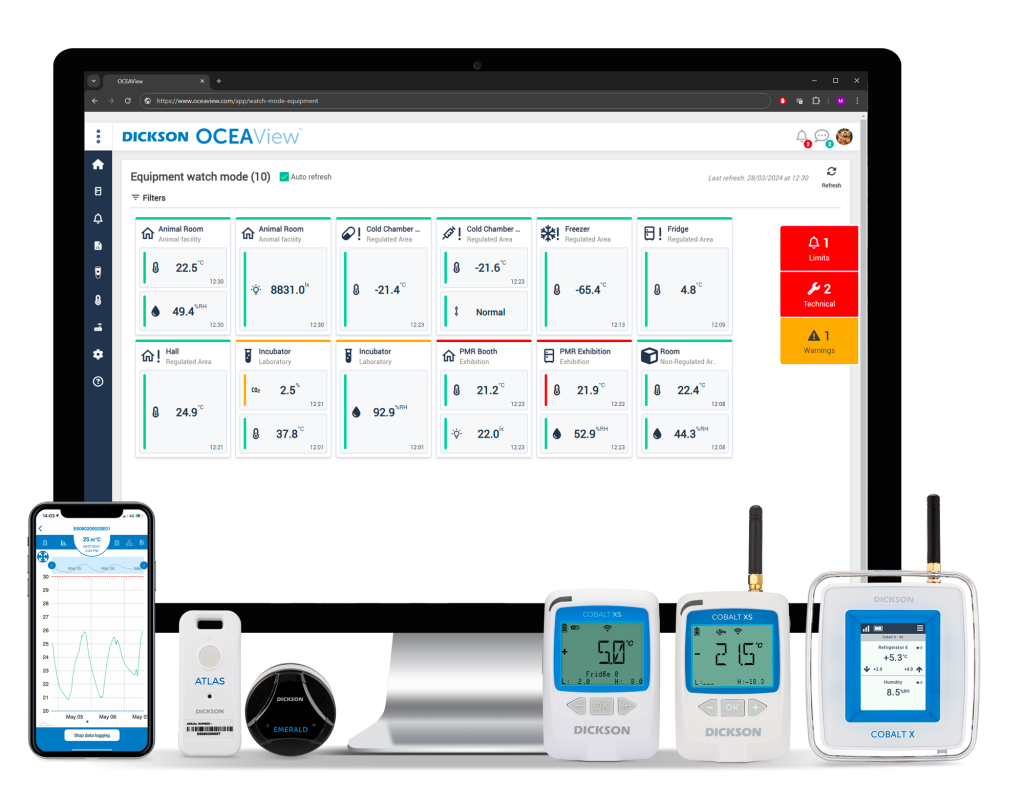
To streamline workflows, you need a single, centralized system that provides a live view of all your assets, regardless of their physical location. This makes it easy to maintain consistent standards and scale your operations as your organization grows.
Having live data pulled into a single dashboard makes it easy to scale as your organization grows by:
- Supporting a wide range of sensors and data loggers from temperature and humidity monitoring, to differential pressure for cleanrooms and carbon dioxide for incubators.
- Managing multiple devices at once across multiple refrigerators, incubators, cleanrooms, labs, and warehouses.
- Providing a live view of all your monitored assets, such as floor plans with color-coded alerts to help teams quickly pinpoint the exact location of an excursion.
4. Can you customize alerts so we only get the notifications we need?
To prevent alarm fatigue, your monitoring system must be flexible enough to distinguish between a routine event, like a brief door opening, and a genuine excursion. This ensures your staff remains attentive to the alerts that truly matter.
Customizable Alerts: Use smart delays and custom thresholds to reduce nuisance notifications and focus your team on critical events.
Automated Escalation: The platform must feature automated escalation paths. If a primary user doesn’t respond, an alert should be automatically routed up the chain of command, providing a documented, closed-loop response.
Role-Based Notifications: The system should direct alarms to individuals based on their specific job function and schedule, ensuring the right expert is always alerted via their preferred channel (text, email, or phone call).
5. How quickly and easily can I generate reports?
When an auditor requests a report, you should be able to provide it quickly and confidently. A key feature of a quality environmental monitoring system is the ability to easily generate comprehensive reports for any timeframe, location, or piece of equipment.
Scheduled & On-Demand Reports: Set up automated report delivery to key stakeholders to make data review a consistent part of your workflow.
Easy Exporting: The ability to quickly export data to a CSV file is essential for further analysis or for providing specific data sets to auditors.
Complete History: Reports should include a full history of any excursions, comments, and corrective actions taken during the specified timeframe.
6. What support does the manufacturer provide?
The best technology is only as good as the support behind it. A true partner offers a full suite of services from installation and system validation (IQ/OQ) to ongoing annual sensor calibration and 24/7 technical support. A strong partner will support you through the system’s entire lifecycle, offering features like easily replaceable temperature and humidity sensors to minimize downtime and even leveraging data for predictive maintenance alerts.
Expert Validation: Look for partners with a team of validation engineers who can help execute IQ/OQ protocols to ensure your system is compliant from day one.
Ongoing Maintenance: A robust service plan should include annual system checkups to review configurations and update user access, evolving the system with your needs.
24/7 Support: For critical pharmaceutical manufacturing operations, access to 24/7 expert support is non-negotiable.
Choosing the right environmental monitoring strategy is a critical investment. By prioritizing the six key features—secure records, data backups, a centralized platform, smart alarming, flexible reporting, and comprehensive support—you build a foundation for proactive compliance and operational excellence.
A cloud-based or on-premise platform like Dickson’s OCEAView monitoring system is designed to embody these pillars in several key ways:
- It’s developed by a globally certified company (ISO 9001, ISO 14001, and ISO 17025).
- It meets the requirements of multiple regulatory bodies, including FDA, GxP, and HACCP.
- The platform is compatible with a wide range of data loggers and sensors for monitoring temperature, humidity, differential pressure, and CO2.
- It adapts to new standards through automatic software updates and customizable parameters, providing a foundation for continuous audit readiness and long-term peace of mind.
We have a lot of experience helping pharmaceutical manufacturers get the most out of their monitoring systems. Contact a Dickson expert today if you want to learn more.
What Is OPC UA, and Why Does It Matter for Regulated Industries?
If you work anywhere near a plant floor, a cleanroom, or a hospital facilities team, you’ve probably heard the term OPC UA, usually in the…

Temperature Mapping for Pharmaceutical Storage and Distribution
Temperature mapping and monitoring is an important part of storing and handling pharmaceutical products. Here are the basics of temperature mapping protocols.

Cloud Storage Transforming Environmental Monitoring Compliance within Pharma
Cloud-based IT platforms have several advantages for highly regulated industries. Here, we’ll discuss the role of cloud computing for environmental monitoring in pharma/biotech manufacturing and...

The Value of Role-Based Alarm Templates
Best Practices for Closing Coverage Gaps and the Role-Based Alarm Advantage Imagine it’s 2 a.m. on a holiday weekend, and a freezer excursion begins. In…
Ready to chat?
Talk To A Specialist
Our trained team of professionals is ready to help you through the compliance process from start to finish. Reach out today to start the conversation. Call (630) 563-4209 or send us a message.