



Did you miss our recent “Audit Ready in Any Season: Modern Mapping & Validation” webinar, or want to revisit the highlights? We’ve got you covered.
In this session, Dickson experts Mark Friske (Mapping Solutions Manager) and Antoine Nguyen (VP of GxP & Compliance), along with host Evan Smith, guided attendees through the fundamentals of thermal mapping, compliance expectations, seasonal considerations, and best practices for warehouses, chambers, and cold storage environments.
The session also featured a live demo of Dickson’s new Mapping Suite, showcasing how the platform streamlines study setup, automates data collection, enables real-time monitoring, and generates audit-ready reports, helping teams reduce manual effort and ensure compliance across every season.
We received many questions during this session, and not all could be answered live. We’ve included a full Q&A recap in this blog post so you can dig into the details and apply them to your own monitoring setup.
Thank you to everyone who attended! Stay tuned for our next webinar.
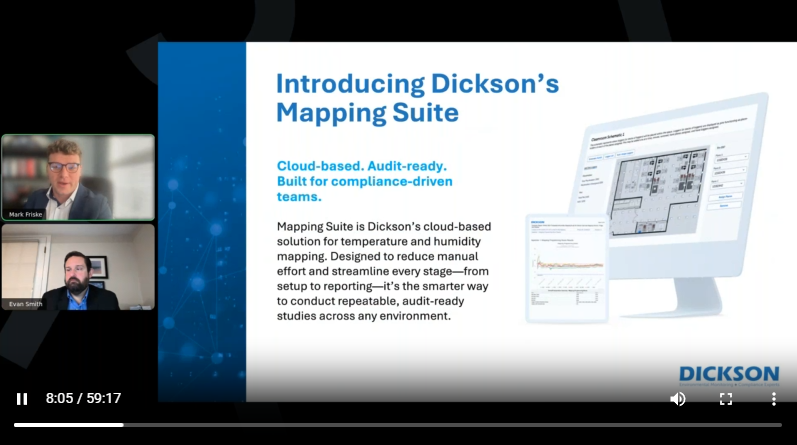
Missed it live? Watch the full webinar on-demand and catch every insight.
Handouts

Questions & Answers
We received a number of thoughtful questions during the webinar. Here’s the recap.
It is standalone. It does not require a connection to DicksonOne or OCEAView.
No. Reports export as PDF only, and data exports as CSV.
There is no minimum or maximum. Sensor count is dictated by space size and regulatory expectations. Mapping Suite scales to large studies (300+ loggers) as long as enough gateways are used.
No. It is designed for short-term mapping studies, not continuous monitoring. Permanent monitoring should be done via DicksonOne or OCEAView after mapping determines logger placement.
Follow the standards relevant to your region (WHO, ISPE, PDA, USP). FDX 15140 applies in France and is supported in the Dickson Mapping Suite.
No. Users upload their own schematics (2D or 3D).
No. Rooms must be mapped under each actual condition of use. Conditions (e.g., 25°C vs 30°C) must be mapped separately even in identical chambers.
Only if it is a more accurate reference device (meeting 4:1 accuracy rule). Otherwise, it should not be used for comparison.
No upper limit. Only requirement is having enough gateways to handle the RF traffic. Each kit includes one gateway.
Suitable: Ovens, refrigerators, freezers, incubators, ULTs (with the correct sensor kit).
Not yet designed for: Autoclave sterilization cycle validations (S-values, D-values).
Yes, but only with the -80°C-specific kit. Other kits will not perform reliably at -80°C.
Loggers communicate to the gateway via LoRaWAN, not cellular.
The gateway uses cellular/Ethernet/Wi-Fi/LoRaWAN to communicate data to the cloud.
For freezers, preferably use an external probe, not the entire device inside.
Maximum load should be set using a risk assessment (often ~80% of expected capacity). Test slightly above operational load. Mapping is not assumed to be linear; airflow can change under different loads.
Launched in mid–2025 in North America.
Strong customer feedback is driving rapid iteration.
A major update is coming around the New Year with feature enhancements, including FDX 15140 support.
Yes. Contact a Dickson Compliance Expert to discuss your specific needs.
It depends. Contact a Dickson Compliance Expert to discuss your existing setup and needs.
Yes. Individual data points from all loggers can be downloaded in CSV format.
Longer logging intervals can be insufficient for certain applications. We recommend using a logger capable of variable intervals. Contact a Dickson Compliance Expert to discuss your existing setup and needs.
It depends on your space and requirements. There’s no fixed number. RH probe quantity should be based on a risk assessment, the warehouse layout, airflow patterns, and whether humidity is a controlled parameter.
Maximum load should be defined through a risk assessment based on how the space or equipment is typically used. Mapping is not assumed to be linear, airflow and performance can change at different load levels, so each condition should be evaluated independently.
There are no universal defrost-cycle standards. Requirements vary by equipment design, manufacturer specifications, and product sensitivity. Most organizations document expected defrost behavior (duration, frequency, and temperature limits) and verify it through qualification or mapping rather than relying on fixed values.
Typically, absolute temperature values are used, since continuous monitoring must capture worst-case conditions. Averages can mask excursions, so placement is usually based on identified high-risk or extreme points found during mapping.
Dickson Mapping suite has live monitoring of ongoing studies. Connecting a PC to a large display can accomplish this.
Pausing dataloggers is performed individually within Mapping Suite.
Excursions are when temperature and humidity are out of range for the space you monitoring. This will vary depending on regulatory guidelines. Warnings are set to help prevent excursions. Users should consider setting a warning point at which the variables are drifting beyond normal fluctuations to prevent excess alarms.
Tight temperature and RH control is most critical in regulated environments such as pharmaceuticals, biotech, medical devices, healthcare, food storage, and certain logistics operations. These industries rely on controlled conditions to protect product quality, safety, and regulatory compliance.
Placement depends on the cleanroom layout, airflow patterns, risk areas, and regulatory expectations. Most organizations use a risk-based approach, placing loggers where conditions are most likely to vary rather than relying on a set distance.
Use a risk-based approach, place sensors in areas most likely to vary, include multiple elevations when needed, use calibrated equipment, document your process, and map under actual operating conditions, including seasonal extremes when applicable.
There’s no fixed number. Sensor quantity depends on the size and complexity of the space, the level of control required, and your risk assessment. Mapping Suite can support small studies to large warehouse grids. Use as many sensors as needed to characterize the environment properly.
Additional Questions?
We’d love to show you how Dickson Mapping Suite can help streamline your thermal mapping. If you would like to learn more, connect with our team of Environmental Monitoring Experts to discuss your needs.
Share With a Colleague
Know someone who would benefit from learning more about Dickson Mapping Suite? Whether it’s a compliance manager, facilities lead, or decision-maker evaluating monitoring systems, share the recording and resources. Together, we can help more teams modernize their monitoring, simplify compliance, and safeguard critical assets.

The Value of Role-Based Alarm Templates
Best Practices for Closing Coverage Gaps and the Role-Based Alarm Advantage Imagine it’s 2 a.m. on a holiday weekend, and a freezer excursion begins. In…
6 Must-Have Environmental Monitoring Features for Pharma Manufacturers
For pharmaceutical manufacturers, you know environmental monitoring systems are a key part of any quality management system, essential for pharmaceutical storage control, and serve as…

DicksonOne Refresher: Back to the Basics Webinar Recap
Did you miss our recent DicksonOne Refresher: Back to the Basics webinar, or want to revisit the highlights? We’ve got you covered. In this session,…

Cloud-Based Monitoring and CAP & CLIA Accreditation
Earning and maintaining College of American Pathologists (CAP) and Clinical Laboratory Improvement Amendments (CLIA) accreditation requires meticulous monitoring and record-keeping of environmental conditions. The accuracy…
Ready to chat?
Talk To A Specialist
Our trained team of professionals is ready to help you through the compliance process from start to finish. Reach out today to start the conversation. Call (630) 563-4209 or send us a message.