



Vaccine temperature monitoring is the practice of recording and documenting storage temperatures for every vaccine-holding unit, then keeping that data on file as proof of proper handling.
The Centers for Disease Control and Prevention (CDC) requires this of every Vaccines for Children (VFC)-enrolled provider. Manufacturers, accreditation bodies, and state health departments increasingly expect non-VFC facilities to also hold themselves to the same standard.
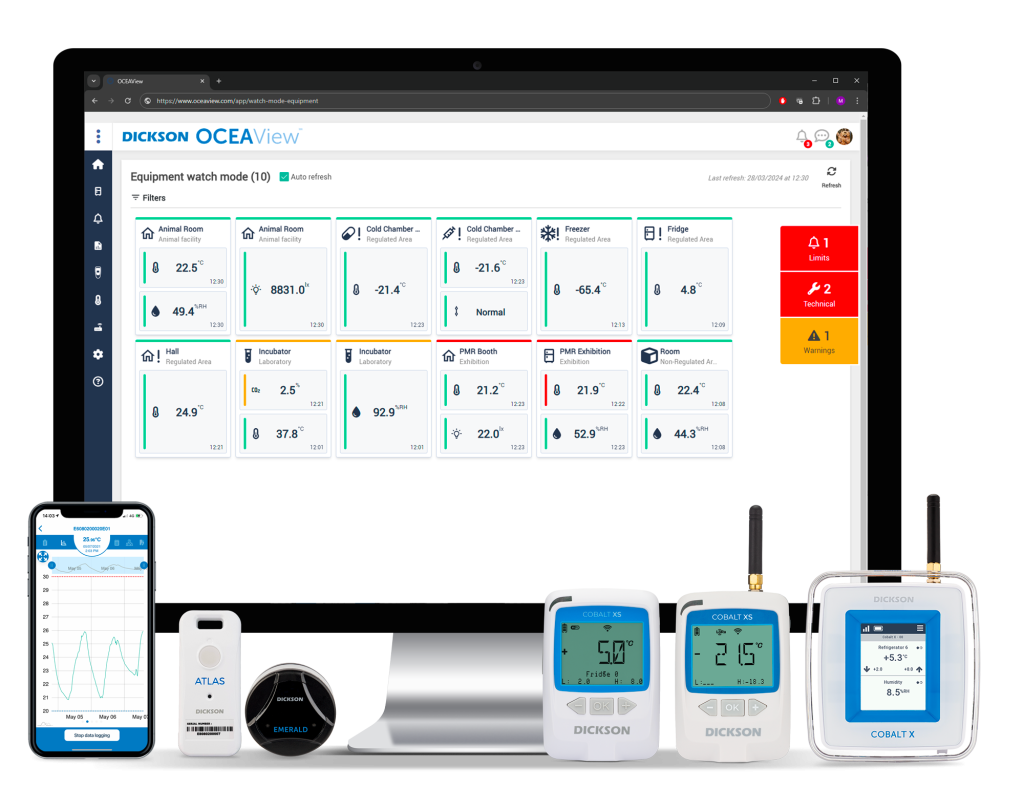
Vaccine temperature monitoring requires continuous logging of storage temperatures with a calibrated digital data logger. The right monitoring equipment and procedures help to catch excursions early, protect potency, and produce an audit trail that meets CDC and VFC Program requirements.
This article covers the basics: what’s required, how to evaluate a monitoring system, and how to move forward. For patient-safety considerations and recordkeeping standards, see Safe Vaccine Storage Protects Patients. For practical guidance on vaccine monitoring compliance, see 5 Vaccine Temperature Monitoring Best Practices.
CDC and VFC Vaccine Storage Requirements
The CDC and VFC program require vaccine storage environments to be continuously monitored and documented. Core requirements include:
- Continuous temperature monitoring for every storage unit
- Calibrated devices with a current certificate of calibration
- Documentation of temperature excursions as they occur
- Written corrective action procedures for out-of-range readings
- Records retained for at least three years
Requirements vary by state, so always confirm current CDC and VFC guidance to keep your environmental monitoring compliance program up to date.
Vaccine Temperature Monitoring vs. Temperature Mapping
Monitoring and mapping solve different problems. Temperature monitoring tracks conditions inside a storage unit over time, so you know a vaccine stays in range. Temperature mapping is a periodic study that finds hot and cold spots within a unit, so you know where to place the sensor.
The WHO recommends mapping new cold or freezer rooms during commissioning; the same logic applies at the refrigerator level. Monitoring without mapping means a device could be recording accurately from the wrong spot.
CDC Guidance on Continuous Monitoring and Buffered Probes
The CDC recommends continuous monitoring with a temperature data logger rather than manual spot checks, since gaps between checks are exactly when excursions go unnoticed. It also recommends a buffered temperature probe immersed in glycol or glass beads, since vaccine temperature changes more slowly than the surrounding air. A buffered reading reflects the vaccine itself rather than short-lived air swings from door openings.
Calibration and Recordkeeping for Compliance
Calibration confirms a device’s ability to measure temperature accurately, and since devices drift over time, recalibration on a set schedule is essential. Dickson simplifies recalibration with pre-calibrated sensors you can swap in without taking monitoring offline.
The CDC recommends retaining temperature logs for at least three years and reviewing data on a regular schedule. Facilities monitoring multiple data loggers across units benefit from a monitoring system such as DicksonOne, which keeps that history centralized and accessible, so retention requirements don’t turn into a scramble at audit time.
What to Look for in a Vaccine Temperature Monitoring System
Not every temperature monitoring solution is built to scale or hold up under audit. The table below outlines what to look for:
|
Question to Ask |
Why It Matters |
|
Does it monitor more than temperature? |
Humidity, CO2, and pressure also impact vaccine efficacy, so a single-parameter sensor may fall short. |
|
Does it scale from one refrigerator to a multi-site network? |
Growth shouldn’t require a full redesign of your environmental monitoring platform. |
|
How many alert thresholds and users does it support? |
A single text alert isn’t enough once multiple sites or shifts are involved. The system should also be able to route alarms to the right people by severity. |
|
How is calibration handled? |
A simple sensor exchange keeps monitoring running continuously, while shipping the whole unit out adds downtime and cost. |
|
Does reporting satisfy 21 CFR Part 11 on its own? |
Manual reporting before an inspection adds risk and time an audit-ready system shouldn’t require. |
What to Look for with an Environmental Monitoring Provider
The software and hardware behind your temperature monitoring system is only part of the decision. The expertise and responsiveness of the provider is equally important. Here’s what to look for:
Installation support that matches your team’s bandwidth. Some organizations self-install; others want a partner to handle configuration or full turnkey setup. Dickson offers all three, through self, hybrid, and turnkey installation and service tiers.
Validation expertise, not just equipment. IQ/OQ/PQ documentation should come from a team that understands GxP environments. Dickson’s validation services are led by compliance specialists who supply audit-ready documentation with the traceability records auditors expect to see.
Ongoing care, not a one-time sale. Maintenance checks, extended warranties, and training keep a system reliable for years. Dickson’s Expert Care Solutions plans bundle this support so it doesn’t fall entirely on in-house staff.
Asking these questions upfront, whether you’re evaluating Dickson or another provider, is what keeps a system compliant and reliable well past the first audit.
What Is OPC UA, and Why Does It Matter for Regulated Industries?
If you work anywhere near a plant floor, a cleanroom, or a hospital facilities team, you’ve probably heard the term OPC UA, usually in the…

Temperature Mapping for Pharmaceutical Storage and Distribution
Temperature mapping and monitoring is an important part of storing and handling pharmaceutical products. Here are the basics of temperature mapping protocols.

Cloud Storage Transforming Environmental Monitoring Compliance within Pharma
Cloud-based IT platforms have several advantages for highly regulated industries. Here, we’ll discuss the role of cloud computing for environmental monitoring in pharma/biotech manufacturing and...
6 Must-Have Environmental Monitoring Features for Pharma Manufacturers
For pharmaceutical manufacturers, you know environmental monitoring systems are a key part of any quality management system, essential for pharmaceutical storage control, and serve as…
Ready to chat?
Talk To A Specialist
Our trained team of professionals is ready to help you through the compliance process from start to finish. Reach out today to start the conversation. Call (630) 563-4209 or send us a message.