



Advances in communications technology over the last decade, especially in wireless communication, have enabled the widespread use of cloud-based data storage in the pharmaceutical/biotech and healthcare industries.
In a cloud system, data is physically stored in a remote location, where it can be accessed by authorized users from anywhere. This approach has several advantages, including a high degree of flexibility, scalability, and ease of use compared to onsite data storage. Dickson leverages cloud storage in our DicksonOne system, which integrates networks of environmental sensors in a centralized web-based platform.
In this article, we’ll cover some of the details of cloud computing in the pharmaceutical space (‘pharma cloud computing’), how it is used, and the major reasons that companies are migrating to cloud-based infrastructures.

How Dickson and the Pharma Industry Use Cloud-Based Information and Data Storage
Cloud computing within a pharmaceutical environment involves storing data on internet-connected servers so it can be accessed, processed, or downloaded as needed. Adoption in regulated industries such as pharma has accelerated significantly and is expected to reach 62.39 billion by 2033, as organizations recognize the operational and strategic value of a cloud infrastructure.
Several models of cloud storage are used in the industry, defined primarily by who has authority for and manages the system:
- Hybrid Cloud: blends public and private environments, including use of a public cloud for less sensitive tasks while keeping confidential data in a public cloud, offering a balance of cost-effectiveness and security.
- Public Cloud: use a shared infrastructure from a third-party provider such as Amazon Web Services (AWS), Google Cloud, or Microsoft Azure.
- Private Cloud: are owned and operated entirely by a single organization, either on premise or hosted by a specialized provider.
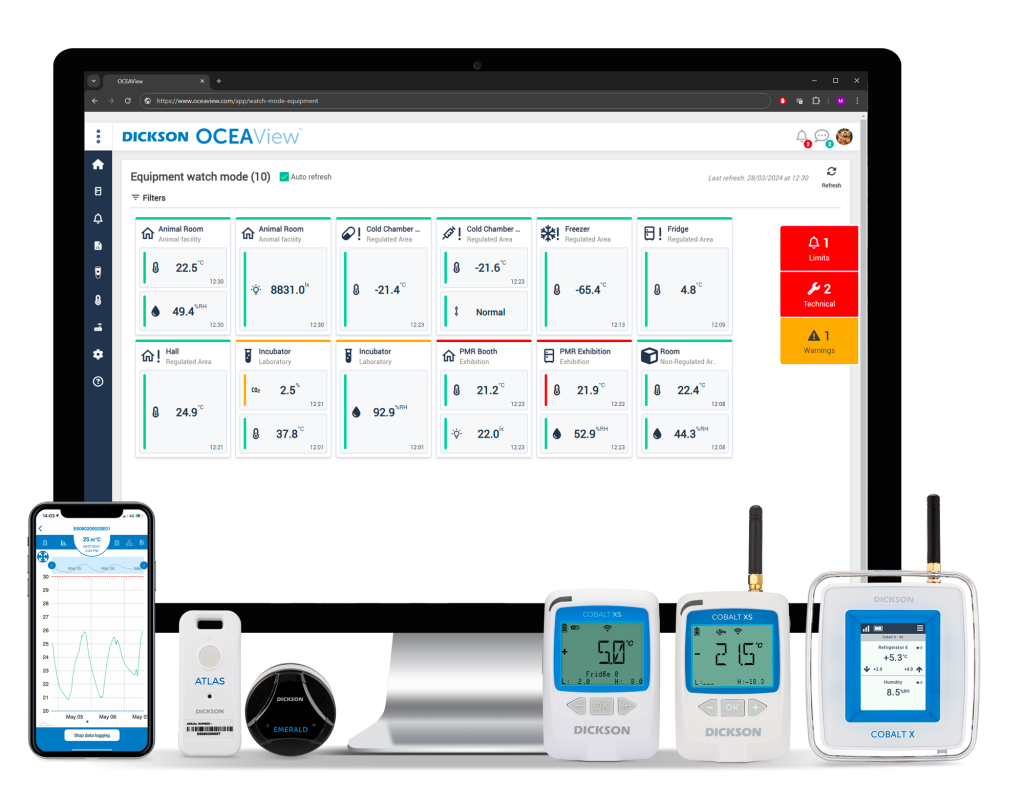
These architectures have unlocked powerful applications in pharma and biotech. The cloud’s strengths—scalability, operational efficiency, and high-grade security—are well suited for temperature monitoring systems that involve large networks of distributed sensors. Dickson uses cloud infrastructure to store, process, analyze, and archive data in an easy to use, intuitive interface to ensure reliable, compliant temperature monitoring.
Cloud Storage Transforming Data Management
Cloud technology has transformed how data is collected, managed, and accessed within regulated environments. Cloud platforms allow the continual upload of sensor data such as temperature, humidity, and other parameters for display within a single interface.
This eliminates the need for manual retrieval from data loggers, improves productivity, reduces the administrative burden for onsite staff and provides continuous audit-ready medical storage monitoring. In a hospital-based pharmaceutical environment for example, a cloud-based system removes the need for personnel to manually check and document temperature readings, allowing more time for direct patient-related responsibilities.
Cloud platforms can help streamline regulatory compliance, with temperature monitoring systems designed to meet 21 CFR Part 11 requirements and other data integrity regulations, helping organizations maintain validated processes and streamline audit preparation.
Security remains a top priority when storing sensitive information such as patient data or manufacturing records. Properly designed cloud platforms can be even more secure than onsite servers, providing:
- Data encryption
- Intrusion detection and prevention systems
- Role-based access controls
- Audit trails
- Secure, access-controlled data centers
- Rapid recovery times
- Automatic and redundant backups to protect against hardware failure
Why Adopt Cloud Computing?
According to the American Pharmaceutical Review, pharma and other healthcare companies are accelerating cloud adoption for several reasons:
1. Scalability
Cloud systems allow organizations to add or reduce storage capacity in response to business needs without purchasing additional hardware.
2. Compliance Auditing and Monitoring
Cloud platforms automatically collect and organize data, enabling complete traceability. Environmental conditions can be tied to specific batches as products move through manufacturing, storage, and distribution, critical for highly regulated processes. Cloud providers such as Dickson provide detailed audit logs that simplify compliance reporting and support regulatory audits.
3. Visibility
Authorized users can access data from anywhere through a secure, centralized interface, with escalating alarm and permission levels. This improves oversight across manufacturing sites, warehouses, labs, and other facilities.
4. Security
Cloud infrastructures provide strong technical safeguards and reduce the risk of data loss through strong encryption protocols, advanced authentication mechanisms, built-in redundancy, routine backups and intrusion detection and prevention systems.
5. Efficiency
Cloud systems reduce the complexity of maintaining physical servers, eliminating inefficient workflows and the need for continuous hardware upgrades as these responsibilities are shifted to a service provider.
Examples of increasing cloud use within life sciences include:
- Healthcare: Hospitals and health systems are using cloud platforms for patient records, environmental monitoring, and data sharing across multi-facility networks.
- Pharmaceutical and biotech R&D: Cloud computing powers modeling, simulations, and other testing such as helping to predict drug-target interactions.
- Environmental monitoring: DicksonOne utilizes a cloud infrastructure to collect and deliver real-time data from distributed monitoring points, whether small or large scale. In a pharmaceutical warehouse for example, temperature loggers continuously upload data to the cloud, where users can review trends, identify out-of-range conditions, and receive instant alerts via text, phone, or email when thresholds are exceeded. Role-based alarms ensure the right person receives the right notification at the right time, improving response time, operational efficiency and reducing possibility of lost products or specimens, protecting patient safety.
Cloud-based data storage continues to be a key advantage within highly regulated industries from pharmaceutical manufacturing to biotech, hospitals and healthcare, providing significant benefits over traditional onsite infrastructure.
The DicksonOne cloud-based platform brings these advantages to the forefront of temperature monitoring, combining robust data logger hardware with secure, scalable cloud technology to deliver reliable, efficient, and audit-ready systems to help enable sound drug discovery, development and delivery for advanced patient care.
To learn more about how Dickson can help support your temperature monitoring needs, contact us today.
Sources: Cloud Industry Forum 2023; Straits Research Feb 2025, “The Benefits of HIPAA-Compliant Cloud Hosting for Healthcare Providers”; HIPAA Vault, American Pharmaceutical Review, “Cloud Computing for Drug Discovery: The Time is Now” Oct 2023
What Is OPC UA, and Why Does It Matter for Regulated Industries?
If you work anywhere near a plant floor, a cleanroom, or a hospital facilities team, you’ve probably heard the term OPC UA, usually in the…

Temperature Mapping for Pharmaceutical Storage and Distribution
Temperature mapping and monitoring is an important part of storing and handling pharmaceutical products. Here are the basics of temperature mapping protocols.

6 Must-Have Environmental Monitoring Features for Pharma Manufacturers
For pharmaceutical manufacturers, you know environmental monitoring systems are a key part of any quality management system, essential for pharmaceutical storage control, and serve as…

Expert Care Environmental Monitoring Services
What Are Expert Care Solutions? A Guide to Dickson’s Support Services From Setup to Long-Term Compliance, Here’s How Expert Services Protect System Performance and Reliability…
Ready to chat?
Talk To A Specialist
Our trained team of professionals is ready to help you through the compliance process from start to finish. Reach out today to start the conversation. Call (630) 563-4209 or send us a message.