


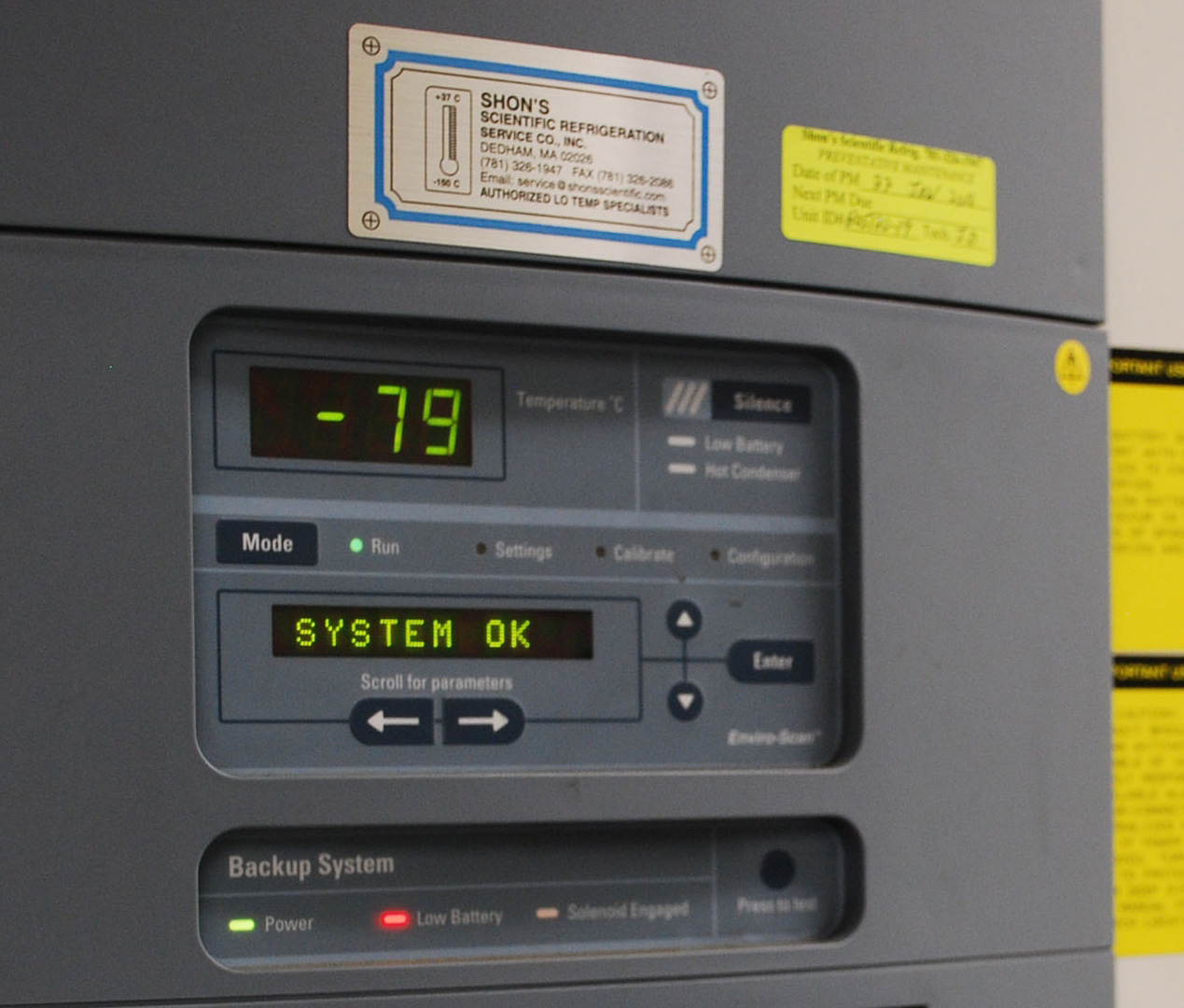
http://blogs.nature.com/news/files/2012/06/HBTRC-Freezer-U-Pannel-6.20121.jpg
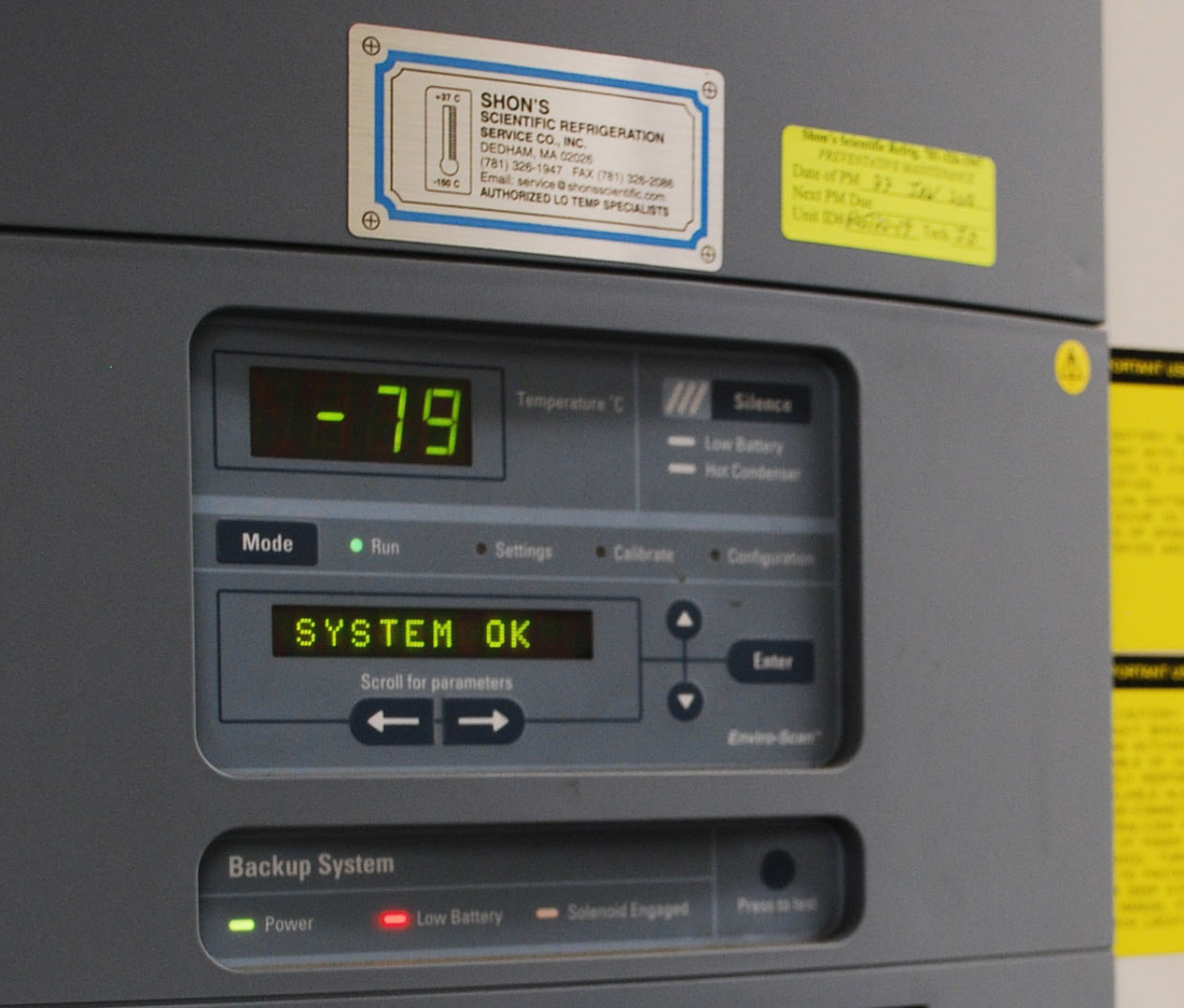
Last week we discussed a Good Morning America story on improper vaccine storage. This week there’s another story about properly monitoring refrigerators/freezers where vital materials (drugs, vaccines, tissue samples, etc.) are stored.
This time, a freezer at the Harvard Brain Tissue Resource Center, storing brain samples from individuals with autism (a collection that was over 20 years old), failed and many of the samples were lost. Sadly, the planets must have been aligned for this event to happen: many of the brain samples had temporarily been combined into one freezer, two monitoring systems failed, and no one entered the freezer for a number of days. While the freezer did have two enabled alarms (they both failed), and an external thermometer (indicating a temperature of -80C), the temperature inside the freezer was -7C, approximately the temperature of your average in-home refrigerator.
Stephen W. Scherer, the director of the McLaughlin Centre for Molecular Medicine at the University of Toronto and a senior scientist at The Hospital for Sick Children in Toronto said “[t]his incident should be a call to action for other storage facilities and the federal government to pay more attention to freezer safety for the sake of science and donor families.”
In light of the recent reports about improper storage, it is important that clinicians, doctors, nurses, etc. heed Scherer’s advice and are monitoring their vital refrigerators with an increased focus. While samples in the failed freezer were donated, there value was priceless. Organ samples, drugs, and vaccines all are essential to the world’s health, and losing any number of these materials is detrimental to the research and distribution of medicine.
This incident stresses the importance of multiple redundant temperature monitoring solutions, especially because that redundancy is cheap. It is smart to have temperature indicators to quickly view the current temperature of the refrigerator/freezer as well as a data logger to record the temperature over time. While indicators are good, they do not give a history like data loggers do and therefore cannot tell you if and for how long vital materials weren’t at their specified range. It is often highly recommended that you use a system that can send email and text alerts. Our DicksonOne is great for monitoring vital applications when those messages are so useful.
Click the Products link up in the menu to start browsing our full line of Continuous Chart Recorders and Data Loggers. If you’d like to speak to an expert directly call: 630-543-3747.
Matt McNamara
DicksonOne Product Manager
Source: Boston.com

Cloud Storage Transforming Environmental Monitoring Compliance within Pharma
Cloud-based IT platforms have several advantages for highly regulated industries. Here, we’ll discuss the role of cloud computing for environmental monitoring in pharma/biotech manufacturing and...
6 Must-Have Environmental Monitoring Features for Pharma Manufacturers
For pharmaceutical manufacturers, you know environmental monitoring systems are a key part of any quality management system, essential for pharmaceutical storage control, and serve as…

Expert Care Environmental Monitoring Services
What Are Expert Care Solutions? A Guide to Dickson’s Support Services From Setup to Long-Term Compliance, Here’s How Expert Services Protect System Performance and Reliability…

Cobalt X and DicksonOne: A Game-Changing Duo
Learn about the integration of DicksonOne and Cobalt X.t. This powerful combination revolutionizes environmental monitoring and management.
Ready to chat?
Talk To A Specialist
Our trained team of professionals is ready to help you through the compliance process from start to finish. Reach out today to start the conversation. Call (630) 563-4209 or send us a message.