



A pharmaceutical cleanroom’s pressure cascade does a critical job: keeping air and everything carried in it moving away from your most sensitive areas. Continuous environmental monitoring gives you documented proof that it’s working across every batch period and audit window, but only if the system is designed and installed correctly.
A well-designed cleanroom differential pressure monitoring program comes down to three things:
1 – How sensors are placed
2 – How your cleanroom monitoring system is configured
3 – How easy the data is to trace and verify in an audit
Here’s what each of those looks like in practice.

Best Practices for Cleanroom Monitoring Systems
Here’s what a well-designed cleanroom differential pressure program does right:
- Sensor Placement
Sensor placement determines whether your differential pressure data is accurate and whether your deviation record is defensible. Two placement decisions determine whether that sensor produces reliable data:
Zone boundary coverage. Each zone boundary — Grade B to Grade C, Grade C to Grade D — needs its own dedicated sensor. A single sensor covering multiple zones can’t tell you which boundary failed, when, or by how much.
Position within that boundary. Locate sensors at the actual differential pressure boundary between adjacent areas, away from supply air diffusers, doors, and high-traffic zones. Industry guidance recommends placing reference measurement points in a protected technical area or interstitial space between the cleanroom and building envelope, shielded from door events and external differential pressure fluctuations.
- Environmental Monitoring Configuration
Alarm delay configuration is one of the most consequential decisions in a differential pressure monitoring program. It is also one of the most frequently overlooked. Two failure modes are equally common:
Delays set too short trigger an alarm on every door opening, producing alert fatigue that leads staff to override notifications and miss genuine failures.
Delays set too long allow real differential pressure failures to go undetected before they affect product quality or generate a deviation.
The right parameters come from your risk assessment and should be validated as part of your monitoring qualification specific to your facility’s door frequency, zone criticality, and validated operating ranges.
- Data Traceability
When a differential pressure excursion occurs, correlating it with temperature and door activity is what turns a deviation record into an actual explanation. Two scenarios consistently create traceability gaps:
Differential Pressure data in a standalone system. If differential pressure records can’t be viewed alongside temperature monitoring, humidity monitoring, and door open/close data from the same window, deviation investigations require manual reconciliation across disconnected sources, introducing delay and error risk.
Differential Pressure data in a building management system not integrated with your EMS. A BMS captures differential pressure readings but typically doesn’t produce the time-synchronized, audit-trail-capable record a GxP inspection requires. When a regulator asks for the environmental record for a specific batch period, the answer should come from one system.
What the Regulatory Frameworks Require
Across every major framework governing pharmaceutical cleanrooms, the expectation is consistent: pressure differentials must be defined, continuously monitored in critical areas, and documented in a system that produces retrievable, audit-trail-capable records. Here’s what that looks like from a regulatory perspective:
International Organization for Standardization (ISO) 14644-2 requires a documented, risk-based monitoring plan that demonstrates ongoing environmental control between certification cycles. For facilities where differential pressure is a critical parameter, that plan must address continuous monitoring, not just periodic verification.
ISO 14644-4 addresses pressure differential requirements in cleanroom design, establishing the engineering basis that monitoring programs are built on.
World Health Organization (WHO) Technical Report Series 1044, Annex 2 (2022) is the primary Good Manufacturing Practice (GMP) reference across many Asia-Pacific (APAC) and international markets. It specifies that pressure differentials between Grade B and adjacent areas be continuously monitored, with expectations for Grades C and D scaled to contamination risk.
International Council for Harmonization guidelines and Pharmaceutical Inspection Co-operation Scheme guidance serve as the primary GMP references for many APAC regulatory authorities. Facilities should verify applicable national requirements alongside these international frameworks because electronic records requirements, including audit trail and data integrity standards, vary by jurisdiction.
For sterile compounding and hospital pharmacy environments operating in the APAC region, applicable national pharmacy regulations and GMP guidelines should be verified against WHO TRS 1044 and ICH Q7, as compounding-specific differential pressure documentation requirements vary by country and regulatory authority.

How Dickson Fits Into Your Cleanroom Monitoring Program
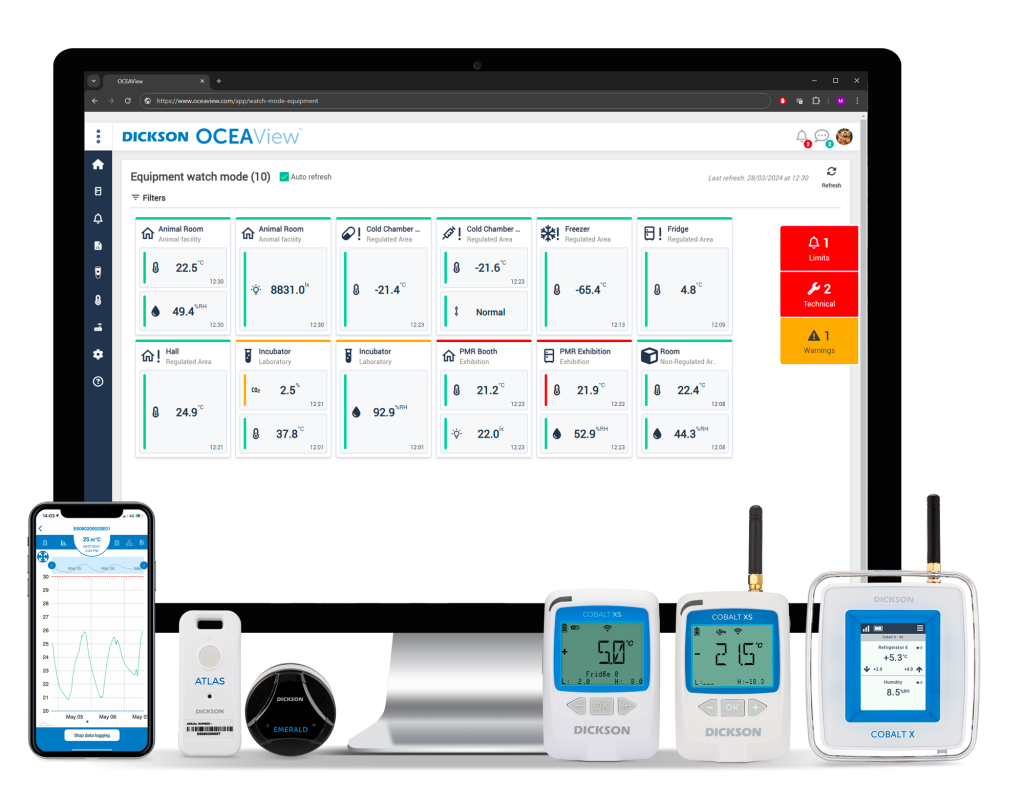
Unlike other environmental monitoring systems, you don’t have to replace existing infrastructure with Dickson’s OCEAView Cloud or On-Premise platforms. Dickson’s Cobalt X data logger accepts a universal 4-20 mA input, capturing output from already-installed differential pressure transmitters alongside temperature, humidity, CO₂, and door open/close data, all in one audit-trail-capable platform.
Here’s what that means for your monitoring program:
Your differential pressure data is no longer isolated. All environmental parameters (differential pressure, temperature, humidity, CO₂, and door open/close) are time-synchronized in one system, so deviation investigations and batch documentation draw from a single, coherent record.
Your audit trail is built in. DicksonOne produces exportable reports with complete access logs, alarm acknowledgment records, and calibration history, meeting FDA 21 CFR Part 11 requirements without manual data assembly.
Your compliance program runs on one validation. One platform, one set of access controls, one calibration schedule. This reduces the administrative overhead of maintaining a standalone differential pressure monitoring system alongside your other environmental parameters.If your cleanroom differential pressure monitoring isn’t producing audit-trail-capable records alongside your temperature and humidity data, talk to a Dickson expert about making sure that a complete record exists and is ready when you need it.
What Is OPC UA, and Why Does It Matter for Regulated Industries?
If you work anywhere near a plant floor, a cleanroom, or a hospital facilities team, you’ve probably heard the term OPC UA, usually in the…
How to Place Data Loggers for Mapping Studies and 3 Ways Dickson Can Help
When it comes to temperature mapping, these two questions create the most confusion: how many loggers do I need, and where exactly should they go?…
How Compounding Pharmacies Can Build a Defensible Differential Pressure Monitoring Program
For years, differential pressure sat in the background of compounding pharmacy monitoring programs — tracked less consistently than temperature and humidity, and enforced less rigorously….
How Douglas Pharmaceuticals Strengthened Environmental Monitoring and Audit Readiness with OCEAView™
Faced with the need to modernise its environmental monitoring approach across two manufacturing sites, Douglas Pharmaceuticals turned to Dickson to deploy a compliant, centralised, and…
Ready to chat?
Talk To A Specialist
Our trained team of professionals is ready to help you through the compliance process from start to finish. Reach out today to start the conversation. Call +603 749 40758 or send us a message.